Pages

Saturday, July 14, 2012

Fried Asparagus with Miso Dressing


Found on Food 52, I made an adaptation of their adaptation of Nobu Matsuhisa's recipe in his cookbook "Nobu's Vegetarian Cookbook". I used onions instead of leeks and my sauce was thicker and reminiscent (in its consistency) of  Asparagus with Sauce Gribiche. Sauce Gribiche is a classic French sauce - a mayonnaise-based dressing with chopped boiled egg, herbs, and cornichons. I also used only about a 1" depth of oil for frying in a 10" skillet. My cooking compatriot (Lynn) wasn't as delighted with overall dish as I was, she loved the dressing and would also use it on a salad (I agree).


In Chef Matshuhisa's recipe, the leeks are deep-fried until browned, and then the asparagus is fried for a minute or two (depending on its thickness). While the asparagus tasted great, and except for the fact that the asparagus tips get crispy in such a delightful, delicious way, I will - while I will definitely make the other elements as indicated - likely roast the asparagus instead of frying it the next time. I fear neither the technique of frying nor the oil, but I hate dealing with a bunch of oil post-fry. I know you can re-use it but I use oil infrequently in that quantity. Yeah, a little lazy that way, but practical. If you do fry them, you will want to snap off all of the fried tips, dip them in a little dressing and eat them yourself. Just sayin'...

RECIPE: FRIED ASPARAGUS WITH MISO DRESSING

Tuesday, July 3, 2012

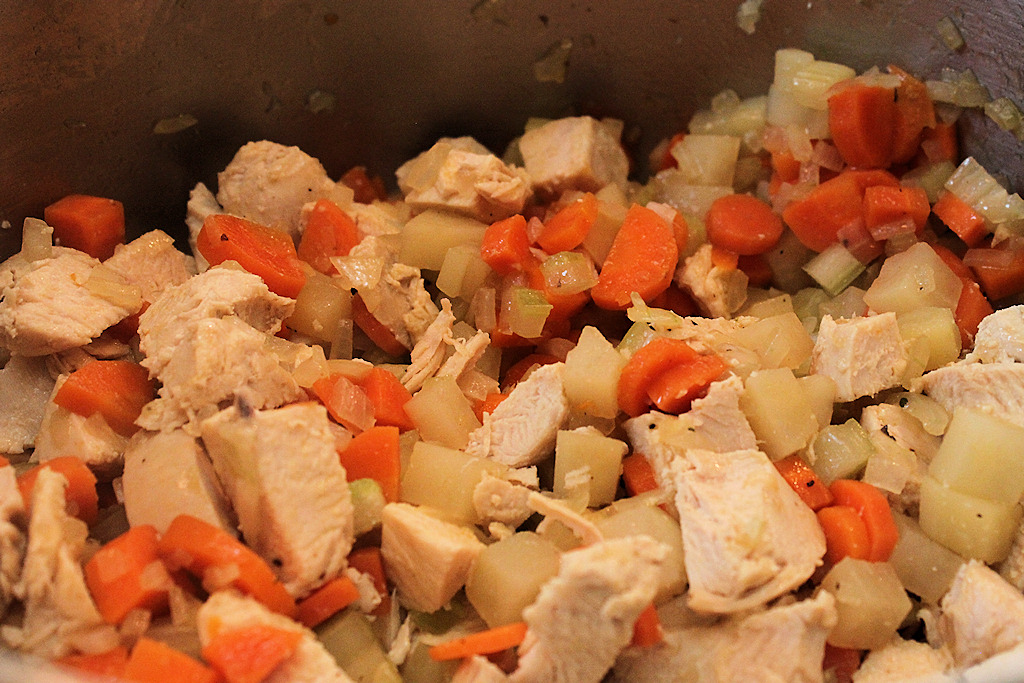
Friday Dinner: Chicken Pot Pie with Savory Crumble Topping


Typically, chicken pot pie comes with a pastry topping that never seems to provide a good ratio of topping to filling once you've served everybody. America's Test Kitchen solved this by creating a recipe that provides a savory, crunchy topping for all. Besides the crispy, tender biscuit-y topping, it's the type of pan in which it's baked that really does the trick. You want a 13" x 9" pan with sides no more than 2 1/2 to 3 inchies high.


I don't think I'm telling tales out of school but if asked, Lynn (my cooking cohort) would be happy with topping, gravy and baby peas. The girl LOVES her baby peas! The topping is comprised of savory biscuit pieces that are first par-baked and then fully browned when the casserole goes into the oven. In fact, all of the filling ingredients are par-cooked and then baked  with the topping to heat everything up and provide the time for the biscuit bits to brown.


We've made this dish three times now. The first time around we made it as written and found it delicious- with two notes: not enough salt and felt it would benefit from some herbs. The second time, it seemed like there wasn't enough filling - and we adjusted the salt and added some thyme (but not enough for us). In between and before we cooked it last Friday, I looked at the recipe. It calls for "3 medium carrots, about 1 cup". Three medium carrots is definitely more than 1 cup so our adaptation includes more salt, the addition of a diced russet potato, herbs and some modification in how the amount of ingredients are defined.


This time was wonderful - although we still think we could increase the amount of herbs. The entire recipe as published calls for 1/2 teaspoon of salt, at one point during cooking the vegetables. It does call for adjusting the seasoning for the gravy to taste but  - and I didn't invent this - it is a conventional recommendation to season as you go.


RECIPE: CHICKEN POT PIE WITH SAVORY CRUMBLE TOPPING

Saturday, June 23, 2012

Friday Dinner: Grilled Steak, Potatoes and Salad with Corn, Tomatoes and Avocadoes

Nothing new or difficult here (except that I added the final butter to the sauce too soon so it was a little 'broken' by the time we served), but just want to memorialize a fun dinner where everything tasted delicious from appetizers through the salad course.

APPETIZER:
Acme baguette slices spread with Heidi Swanson's, "Parmesan Cheese Spread" (left side of the plate) or misozuke tofu (right side of the plate) and garnished with sun dried tomato, quick preserved lemon, roasted red pepper, confit garlic and caper relish - this recipe is at the bottom of the post. It is delicious and could top anything from a baguette to fish or chicken.

 MAIN COURSE: 
Grilled steak with Marchand du Vin sauce, No-Name Potatoes garnished with creme fraiche. However you cook your steak, take it out of the refrigerator at least 30 (I prefer 60) minutes before  cooking. After patting them dry, we generously season with salt shortly before they go onto the grill or into a smoking hot pan on the stove top. Lynn reigns as the steak grilling chef supreme - she has the mojo.


SALAD
Baby greens with grilled corn, cherry tomatoes, avocado and red onion, dressed in a red-wine vinaigrette.

RECIPE: SUN DRIED TOMATO, QUICK PRESERVED LEMON, ROASTED RED PEPPER, CONFIT GARLIC AND CAPER SPREAD

 + Quick 'Preserved' Lemons
 + Confit Garlic

Sunday, June 10, 2012

Friday Dinner: Coq Au Vin - Chicken Stew, to You


In the days of Yore (you know "Yore", it was before your parents' parents were born), when your rooster was too old to chase the hens, you cooked it. Old roosters make for a difficult chew so roasting was out of the question. Tough meat = braise, so maybe you dumped the dregs of your wine barrel (depending on where you lived, the wine might be white or red), some onions and mushrooms (or celeraic or carrots) cooked in the rendered lard of a hunk of salt pork into the pot and cooked Monsieur le Rooster (a 'coq') having been separated into his component parts, until the meat was edible and, "mon Dieu!", you have a sauce. Serve some chicken with a ladle of sauce on top, break off a hunk of bread to sop up the sauce and you have a tasty, filling meal.


One of the first published recipes for coq au vin was in Edmond Richardin's, "La Cuisine Française: L'art du Bien Manger" where he calls for mushrooms AND truffles, in 1906. I'd wager that as long as there has been wine, folks have used it to cook a hearty meat stew, using whatever vegetables were handy to extend the dish as well as for flavor. The preparation for coq au vin is similar to boeuf bourguignon. To thicken a stew, if flour wasn't in your pantry, you used blood from the former Monsieur le Rooster, at the end of cooking.


Nigel Slater wrote, "I once worked in a restaurant that, at the time, was considered to be the best in the land. At least several of the guides thought so. The chef patron had learned to make this dish in France, he understood its roots. We made coq au vin every week (believe me when I say that this is one of those dishes that improves, rather than deteriorates, after a few days in the fridge). I have never made it better than I did under his beady eye, but then we made it with the dregs of the glasses and bottles from the customers' tables. So whether it was the quality of the local birds, the excellent wines or that soupçon of saliva from each glass that made the difference I will never know."


Modern recipes can be tortured and time consuming. We have made it previously, using Julia Child's recipe - actually two recipes: one a "master" recipe for a ragout of chicken and onions in red wine, and the recipe for coq au vin. Not too long ago, we tried the version from America's Test Kitchen, "Modern Coq au Vin" and it was delicious.  The ATK recipe takes less time, but for us, it provided all of the flavor components from a traditional rendition and suits another Nigel Slater quote, "The sort of good-natured food that will fit in with us rather than us having to plan our day around it; the sort to eat off plain white plates on a paper tablecloth. The sort whose juices you mop up with bread and a plain, garlic-scented salad. In other words, a sound recipe that makes all the right noises." Mr. Slater's Coq au Vin recipe can be found here and if I ever run across an old rooster, that's the one I'll use.

We served our coq au vin with a spinach salad with raisin bread croutons, egg, toasted pecans, red onion and avocado and a red wine vinaigrette. Oh yeah, and bacon.
 RECIPES: MODERN (AND QUICKER) COQ au VIN

Sunday, May 20, 2012

Buttermilk Biscuits

Do you swear by butter? Shortening? Butter and shortening? Lard? Roll? Pat? Beaten biscuits? Should you add baking soda? Flour from hard winter wheat (Northern - higher protein) or soft summer wheat (Southern - lower protein)? For a simple recipe that home cooks have been making in a recognizable-even-today form since the late 18th and early 19th century, there are a myriad of variations based on location, availability of ingredients and the state of your household economy.

Countless women (and men, I'm sure) have made batches of biscuits every morning - and some every night. They are 'quick' (non-yeast) breads that in their best form have a great rise, are sturdy enough to hold up to a sausage patty and egg or gravy or, sweetened with a little sugar, a load of fresh strawberries and cream. ...or just a smear of butter and some honey or jam.
If you don't already have a buttermilk biscuit recipe that you think is perfect, give this one a try.

For me, I don't stock shortening or lard and I never remember to buy White Lily (or  King Arthur) soft, summer flour. I don't even have buttermilk in my refrigerator on a regular basis, but I have discovered powdered buttermilk - a righteous and more than acceptable substitution in baking applications. I've included three other buttermilk substitutions in the recipe.

I cut in the butter (refrigerator cold) with my fingers so that the pieces are not entirely uniform - some little pea-size pieces and others that I've rubbed between my fingers into thin flakes. After I've cut in the butter, I stick the flour and butter mixture in the freezer for about 15 minutes before I mix-in ice-cold water (or buttermilk, if you're using it). There are some other tips and all are in the recipe after the jump.

Baking powder. Must. Be. Fresh. If you don't bake too often, buy the little can and throw out what you haven't used once a year. Just do it. Don't make this recipe or any quick bread or biscuit recipe until you: (a) check the expiration date on your baking powder; and if it has passed (b) buy a new can. The small cans are pretty cheap. I also use 1/2 teaspoon of baking soda. Too much of either and there's a noticeable 'off' flavor, but 1 1/4 tablespoons of baking powder and 1/2 teaspoon of baking soda passed my "Super Taster's" (my cooking compadre, Lynn - her palate is more sensitive than mine) taste test.

Biscuit cutters. If you don't have one, don't use a glass - use your knife. The sharp edge of a biscuit cutter or a sharp knife won't drag down the sides of the biscuit. Using a knife to cut your biscuits eliminates the need for re-forming the dough from scraps. Second generation biscuits are never as good as those cut the first time through. Place the biscuits close together on the pan for higher risers and an inch or more apart for crispier tops and bottoms.


RECIPE: BUTTERMILK BISCUITS