Pages

Showing posts with label dinner. Show all posts

Sunday, June 10, 2012

Friday Dinner: Coq Au Vin - Chicken Stew, to You


In the days of Yore (you know "Yore", it was before your parents' parents were born), when your rooster was too old to chase the hens, you cooked it. Old roosters make for a difficult chew so roasting was out of the question. Tough meat = braise, so maybe you dumped the dregs of your wine barrel (depending on where you lived, the wine might be white or red), some onions and mushrooms (or celeraic or carrots) cooked in the rendered lard of a hunk of salt pork into the pot and cooked Monsieur le Rooster (a 'coq') having been separated into his component parts, until the meat was edible and, "mon Dieu!", you have a sauce. Serve some chicken with a ladle of sauce on top, break off a hunk of bread to sop up the sauce and you have a tasty, filling meal.


One of the first published recipes for coq au vin was in Edmond Richardin's, "La Cuisine Française: L'art du Bien Manger" where he calls for mushrooms AND truffles, in 1906. I'd wager that as long as there has been wine, folks have used it to cook a hearty meat stew, using whatever vegetables were handy to extend the dish as well as for flavor. The preparation for coq au vin is similar to boeuf bourguignon. To thicken a stew, if flour wasn't in your pantry, you used blood from the former Monsieur le Rooster, at the end of cooking.


Nigel Slater wrote, "I once worked in a restaurant that, at the time, was considered to be the best in the land. At least several of the guides thought so. The chef patron had learned to make this dish in France, he understood its roots. We made coq au vin every week (believe me when I say that this is one of those dishes that improves, rather than deteriorates, after a few days in the fridge). I have never made it better than I did under his beady eye, but then we made it with the dregs of the glasses and bottles from the customers' tables. So whether it was the quality of the local birds, the excellent wines or that soupçon of saliva from each glass that made the difference I will never know."


Modern recipes can be tortured and time consuming. We have made it previously, using Julia Child's recipe - actually two recipes: one a "master" recipe for a ragout of chicken and onions in red wine, and the recipe for coq au vin. Not too long ago, we tried the version from America's Test Kitchen, "Modern Coq au Vin" and it was delicious.  The ATK recipe takes less time, but for us, it provided all of the flavor components from a traditional rendition and suits another Nigel Slater quote, "The sort of good-natured food that will fit in with us rather than us having to plan our day around it; the sort to eat off plain white plates on a paper tablecloth. The sort whose juices you mop up with bread and a plain, garlic-scented salad. In other words, a sound recipe that makes all the right noises." Mr. Slater's Coq au Vin recipe can be found here and if I ever run across an old rooster, that's the one I'll use.

We served our coq au vin with a spinach salad with raisin bread croutons, egg, toasted pecans, red onion and avocado and a red wine vinaigrette. Oh yeah, and bacon.
 RECIPES: MODERN (AND QUICKER) COQ au VIN

Tuesday, May 1, 2012

Roasted and Stuffed Prosciutto-Wrapped Pork Loin, No-Name Potatoes and Citrus Salad


I swear that this is (probably nearly) the last post for things made in 2011, but it's a great dish that we made for our 2011 New Year's Eve dinner. We'd been planning to make this pork loin roast since October 2011 when Lynn saw it in Bon Appetit. None of the components are difficult for the pork loin but there was a serious error in the original recipe when it came to cooking temperature and time - which I address in the recipe's head notes after the jump. 

Fortunately, others had gone before and there was very good information in the reviews. Ours looked like the roast in the magazine's picture and tasted like something you'd gladly open your wallet to pay for in a restaurant. It was all kinds of awesome.

A pork loin is butterflied, a layer of pre-wilted kale is spread on top, and on top of that a mixture of pork sausage, reconstituted dried mushrooms and apples, thyme and rosemary. The loin is then rolled and wrapped in a layer of prosciutto, tied and garnished with rosemary, browned briefly and roasted.
I was at Sur La Table looking to buy some kitchen twine because Lynn was out. All they had were ridiculously expensive (and small) packages of kitchen twine and these re-usable silicone bands for about the same price.  I have poo-pooed these in the past because tying your own roast or other cut of meat when called for is something you should know how to do.  However... the bands work beautifully, are easy to remove and easy to clean. These bands wouldn't work for every application, but they were perfect for this roast. Yay, technology!
Hello luv-ah!


I can't figure out what to name the potatoes. The closest I've come is "French-Fried Potato Columns" (not entirely accurate and kind of uninteresting), or maybe, "Potatoes Cooked Three-Ways". Ugh. My sister Chris served these a couple of years ago for our family's Christmas Eve dinner and I've been periodically obsessing over them since then.They taste  like french fries on the outside (but are not deep fried) and inside, but are approximately 2" high by 2 to 3" diameter "columns" and so there is a lot of fluffy potato in the middle. I don't eat potatoes very often and when I finally got around to asking her how she made them she didn't remember, didn't know where she'd found the recipe or even if there was a recipe. My research proved fruitless - I couldn't find anything exactly like what I remembered.
The potato "columns" drying after being boiled. After they've dried, the tops and bottoms are sauteed until they're a deep golden brown and then they're popped in the oven for about 15 minutes..

When we were out picking up the roast at Tacoma Boys (on 6th Ave. - great store) and other ingedients for the 2011 Christmas Eve dinner, I cornered her in the cracker aisle and wouldn't let her leave until she'd remembered how she made them. Which she did. I made a test batch for my sister Sara's family and got a unanimous thumbs up.

.The citrus salad was all Lynn's idea: a variety of greens, grapefruit supremes, toasted pecans and avocado in a grapefruit and Sherry vinegar vinaigrette. It was a perfect balance to the rich pork.

It was truly a wonderful way to mark the end of 2011.

RECIPES (after the jump):
- Roasted and Stuffed Prosciutto-Wrapped Pork Loin
- No-Name Potatoes
- Salad with Grapefruit, Toasted Pecans, Avocado and a Grapefruit Vinaigrette

Tuesday, November 22, 2011

Friday Dinner: Chicken Piccata, Fettucine con Burro e Formaggio and the Ham Sandwich Salad

...okay, we didn't serve a ham sandwich as a salad, but the inspiration for the salad started out as a ham sandwich, according to Nancy Silverton, in her book "A Twist of the Wrist". It's also not called "The Ham Sandwich Salad", but "Crispy Hearts of Romaine with Ham, Pickled Jalapeno Peppers and Creamy Avocado Dressing". My older sister served the salad to me the last time I was visiting and I knew I had to make it for Lynn at one of our Friday dinners. The dressing alone just makes me want to weep with happiness. Everything in this salad goes together beautifully.

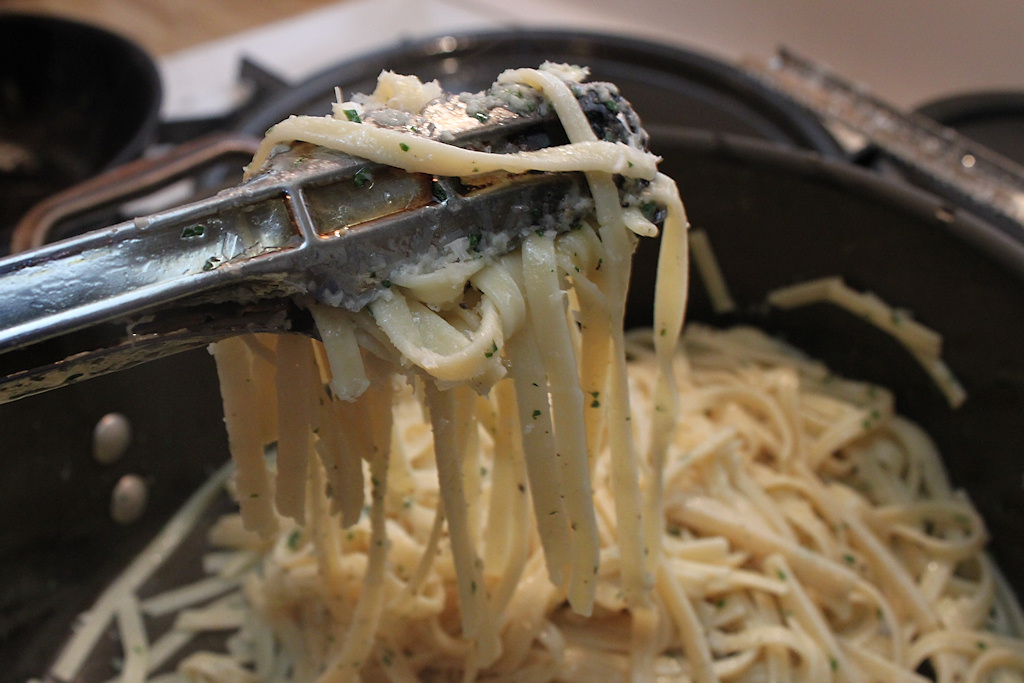
I've eaten Lynn's Chicken Piccata, and pasta with butter and cheese (closer to the original Fettuccine Alfredo than what you eat in restaurants) for years and Friday's incarnation was delicious.  We were talking about when she first made the pasta dish (and whatever pasta you have on hand will work - she most often uses linguine or fettuccine) and she pulled out one of her favorite Italian cookbooks to show me some recipes, "Adventures in Italian Cooking", © 1980, published by Ortho Publishing - a subsidiary of Chevron Chemical at that time. Seriously? Why yes, Chevron had a publishing arm and its subsidiary, Ortho, put out cookbooks. In a way, it's kind of creepy if you think about it too much, but don't. It's a strange source, but one with really good, solid recipes. 

Many recipes call for pounding out the whole half-breast but if your half-breasts are large, making a scalloppine (thin slice of meat) by butterflying the half-breast and just slicing it into two pieces makes a more manageable piece of chicken and takes less pounding time. I've embedded a video that shows how to butterfly a chicken breast. It also helps if your chicken isn't straight out of the refrigerator when you pound it.


Many recipes also call for egg dips and breading which, after sauteing, makes more of a "chicken-fried steak chicken breast",  but Lynn just dusts the pieces with seasoned flour and lets them air dry on a rack before cooking them and I'm in favor of this method, too.


Many moons ago, Lynn lived in the Outer Richmond and her favorite restaurant was Ernesto's (on Clement St.) - back when Ernesto was in the kitchen. Lynn was delighted to be able to recreate many of her favorite dishes from Ernesto's using, amongst other sources, this book. 

Alfredo di Lelio.is credited with the dish "Fettuccine Alfredo" but you know that some form of pasta dressed with creamed butter and cheese has been served since somebody in Italy had water, fire and those three ingredients, but Alfredo has the official credit. Lynn's version includes a healthy dose of fresh ground black pepper and minced parsley. Parmigiana Regiana - at least two years old, is traditional but we used a pecorino romano (sheep's milk) cheese. Don't sweat over the fine details, this remains: pasta dressed with butter and cheese. The only thing about which you must be precise is to wait to dress the pasta until right  before you're ready to serve it. Too soon and the sauce will break (separate). That fact is why the Fettuccine Alfredo we know from most Italian restaurants - at least in the U.S., is a sauce that includes cream as it helps 'hold' the sauce during the restaurant's service period.


Harold McGee has successfully de-bunked the common practice that you need a bunch of water to cook pasta but make no mistake - you need salt. Two tablespoons in the water to cook a pound of pasta in 4-6 quarts of water and if you use the less-water method, two teaspoons to two quarts water.

RECIPES:
 - Chicken Piccata;
 - Fettucine con Burro e Formaggio; and
 - Crispy Hearts of Romaine with Ham, Pickled Jalapenos and Creamy Avocado Dressing

Saturday, October 15, 2011

Lamb Kefta Tagine with Tomatoes and Couscous

I meant to make this last week but ran out of time and stuck the lamb back in the freezer. A friend came to visit this weekend from afar - 17 hour plane ride. We had a lot of catching up to do and I didn't want to be fussing around. I don't multi-task all that well: I can cook a lot or I can talk a lot but I can't do both and I wanted to do the latter but have a good meal. I made this in about an hour, headed down to the airport and when we got back, reheated it, made the couscous, heated up some pita bread in the oven, made a simple salad of greens and vinaigrette and dinner was ready in about 20 minutes.


This is a dinner that you can cook in parts - sauce first - and store it before making the meatballs. It was eaten fast enough that I didn't have any left over to freeze, but I'm guessing it would store very well.


The only part that requires about 20 minutes of continuous effort is making the meatballs. The original recipe specified that the meatballs be the size of large cherries. I made mine about 1" in diameter and added an egg - also not called-for in the original recipe. I used a small ice cream scoop to portion the meatballs. This recipe is a definite keeper and when tomatoes aren't in season, canned will do just fine.

RECIPE: LAMB KEFTA TAGINE WITH TOMATOES and COUSCOUS